
Winner of the 2024 John Brinkerhoff Jackson Prize from American Association of Geographers
Framing Nature: The Creation of an American Icon at the Grand Canyon (2024). University of Nebraska Press.
By Yolonda Youngs
America’s Public Lands (book series editor Char Miller. Acquisition Editor Bridget Barry)
Available as an eBook or paperback
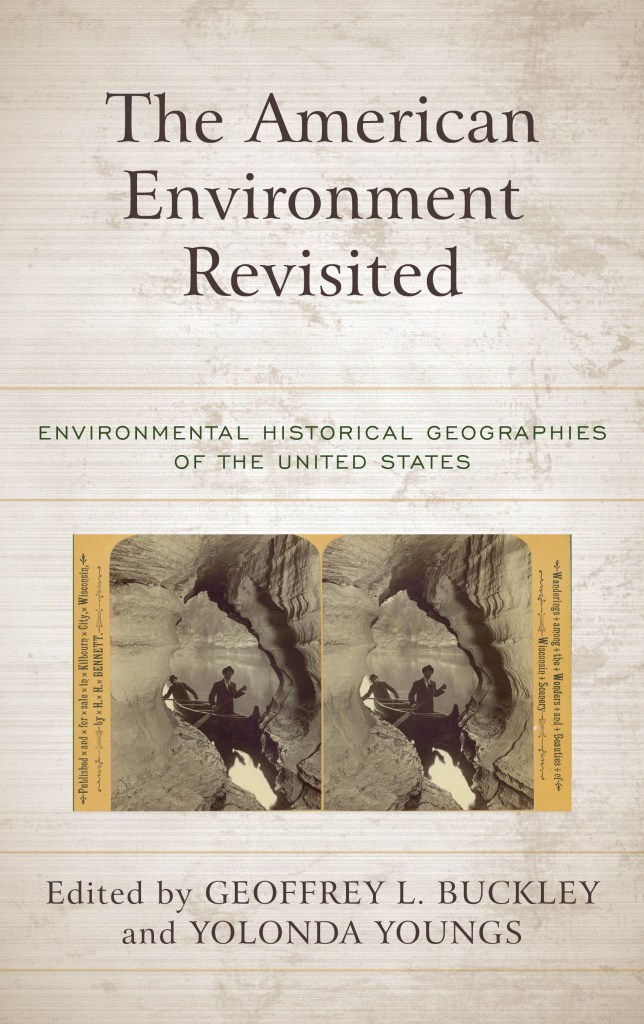
The American Environment Revisited: Historical Environmental Geographies of the United States (2018). Rowman & Littlefield Publishers.
Geoffrey Buckley and Yolonda Youngs (editors and authors)
Available as paperback, hardback, eBook from Bloomsbury Publishing, Amazon, and most major online book selling platforms.
https://www.bloomsbury.com/us/american-environment-revisited-9781442269965/
“An excellent book that advances an understanding of how places such as the Grand Canyon are socially constructed over time, an important and enduring theme within geographical research.”—Lisa Benton-Short, author of The National Mall: No Ordinary Public Space
“In an era of accelerating global climate change, the enhanced understanding Yolonda Youngs provides—of how past manipulations of the Grand Canyon’s visual representation influenced our understanding and management of a signature American national park—will assist us as a society in making appropriate decisions about how to manage such natural resources in the future.”—Peter J. Blodgett, H. Russell Smith Foundation Curator of Western American History at the Huntington Library
“Youngs’s methodological approach yields a rich analysis that is both cultural and material and one that will hopefully inspire future scholars to contribute to a scholarly and public conversation about the process of placemaking.”—Sarah Keyes, H-Environment
The book is worth reading whether you are a devotee of environmental historical geography or not quite sure you’ve heard of this subfield of the larger discipline . . . Buckley and Youngs accomplish quite a bit more than simply revisiting the U.S. environment. They challenge us in diverse ways to rethink our human relationship with a broadly construed ‘nature,’ and they remind us how richly connected history and contemporary experience remain. The contributing authors, as a whole, succeed nicely in situating their work within a tradition of environmental historical geography while also extending the boundaries of this field to redefine and reinvigorate it. As DeLyser notes in the book’s final chapter, ‘Environments of the Imagination,’ these environments—and perhaps more ambitiously, the ideas of the book—‘are everywhere with us’ (p. 332). It’s refreshing to find a resource that reminds us why it is important to continue to engage as fully as possible with them.
– AAG Review of Books
 Yolonda Youngs, Ph.D.